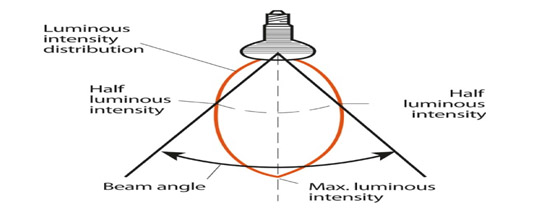
The distribution of light is basically measured by the beam angle of a lamp. By definition, the angle is observed where the light intensity at the outside of the beam has dropped to 50 percent of the maximum light. However, not all lamps with the same beam angle disperse light in exactly the same way.
The distribution can differ remarkably depending on factors as mounted lens-, reflector- and diffuser-type. High quality lenses, reflectors and diffusers will disperse light evenly, which causes the desired
light-density. Contrary to this, cheap material causes unpleasant flickering and glare.
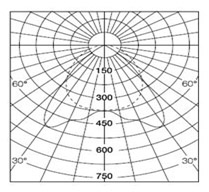
 Light intensity distribution curve - LIDC
Values of luminous intensities shown in catalogue diagrams are unified on luminous flux of a 1000-lm light source. In this way, it is possible to obtain lighting curves of luminaires which are independent on measured luminous flux of used light sources.
Illuminated spaces require different shapes of LIDCs to achieve standards required by particular application or visual task. There are numerous types of lighting fixtures with different optical parts to fulfill these needs. FecosLED© makes sure, that only such material is being used, which guarantees even illumination of the task area without unpleasant effects for the observer.