The color rendering index (CRI) describes the ability of a light source to illuminate objects in natural colors compared with an ideal natural light source like the sun. The CRI perceived by the human eye is measured according to the standard of CIE 1931.
A reliable measurement of the CRI requests the testing of several samples, usually 8 pieces. An average index-value is finally being calculated according to a standard formula.
The CRI of LEDs with a blue chip and phosphor layer usually encompasses the range of Ra >70 to Ra >85. With the use of a more complex phosphor
composition, index-values of up to Ra >95 can be achieved. However, high index-values can only be achieved on the cost of a lower luminous flux. Warm color temperatures render higher CRI-grades, but simultaneously a lower luminous flux.
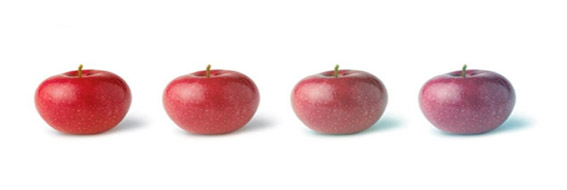
Illuminated surfaces will frequently not look the same under the same light as two lights that appear the same white, may be the result of different blends of wavelengths. A red apple may appear “true” red when seen illuminated by white light produced by a continuous spectrum, but in an equally white looking mixture of yellow and blue light it will look greyish brown. Because of the absence of red wavelengths, there is no red for the apple to reflect into the human eye to notice.
Not under all circumstances artificial light should be represented as naturally as under daylight conditions. In some cases lighting should highlight individual colours or create a specific ambience. There are also various lighting situations where not an exact natural colour rendering matters most, but where illumination level and efficacy are of greater importance.
Colour rendering is an important aspect of artificial lighting and makes it necessary to evaluate the task which an artificial light source is thought to fulfill. Please contact us for further information.