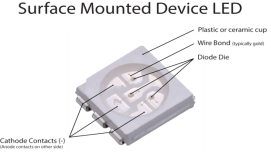
Surface Mounted Device chips (SMDs), have been developed for the use within various kinds of light sources such as strips, bulbs, downlights and tubes. Due to their small size, SMDs can be mounted flexibly into very small devices. SMD-technology allows an individual circuit design for each diode and two, 6 or even more contacts (diode and anode), hence allowing RGB and the creation of any possible colour.
One of the most recent LED development has been
chip on board-technology (COB). Similar to SMDs on every COB chip there are multiple diodes, mostly 9 or more. Unlike surface mounted technology, COB-technology does not require a single circuit for every diode included on the chip, but can only have 1 circuit and 2 contacts for the entire chip regardless of the number of diodes. This single circuit design, regardless of the number of diodes on the chip, leads to simplicity for the rest of any COB LED device and to a higher luminous efficacy per Watt. However, individual levels of light output are not easy to adjust within COBs which is the reason why they cannot be used for colour changing lights.
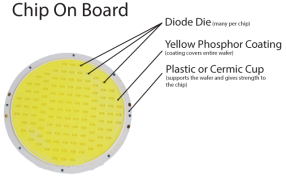
Since the advent of COB chips in the LED industry, a large lumen count can be produced from a single source using a COB chip. This was never possible before COB and has made remarkable saving on energy costs possible. COB chips vary widely in their applications and thus different chips will require different wattage, voltage, and will produce vastly different lumen ouputs. Typically COBs achieve 80 lumens per watt minimum to well over 100 lumen per Watt (lpw).